Showing posts with label wildlife. Show all posts

Monday, June 27, 2011

Summer

June has been quite an unsettled month here in terms of weather - we've had scorching heat and very cold downpours! So it hasn't been the best month for the bees, especially as it is the June gap, but our hives are all doing well fortunately.


This post is a catch-up session about our latest antics and a celebration of the English countryside in summer :)


To start with I should mention a fantastic microscopy workshop that my beekeeper's association organised at the beginning of the month. It was a really excellent day and we were led through the processes of identifying acarine and nosema by our regional bee inspector and two experts from the National Bee Unit - long way to come! It was a fantastic day. I learned to dissect bees in order to check for acarine - a delicate operation that involved removing the head, front legs and 'collar' of a dead bea to reveal its trachea. I managed to get a couple of good dissections and although I'm not sure how often I will have to use this skill I learned such a lot about the anatomy of the honey bee and the beauty of its construction. We also mashed bees up to release their stomach juices, from which we could detect nosema. Using the compound microscopes for this let us see not only the nosema but also some beautiful pollens! I think I was able to tell the very subtle difference between nosema apis and nosema ceranae at one point, although of course it could have been my imagination. Either way, a fascinating exploration of the honey bee and I learned s much about good disease management also. I now have a taste for microscopy, and have ordered a couple of books on the subject...who knows, maybe one day I'll get my microscopy certificate?


Aside from the bees, the countryside has been absolutely stunning this year. Below are some pictures of a poppy field and a field of what I think is flax, both near our apiary site and both absolutely jaw-droppingly beautiful, the photographs hardly doing them justice.

A quick flit to the garden centre revealed some beautiful (and edible!) fuschias.

And finally, I took the dog on one of my favourite walks and was absolutely struck by the beauty of nature that day. The poor dog felt somewhat neglected as I looked around me carefully, trying to look at the landscape from a Permaculture perspective. I could see that the hedgerows and edges of the woodland are naturally scalloped, a design feature that permaculturists often use on borders, and I was amazed that nature just does it naturally! Also the beauty of the chalk stream we visited was amazing. It was alive with tiny shrimp-like creatures and amazingly near to the water the forget-me-nots were still in flower, even when they have finished everywhere else! They made a very picturesque tangle with the watermint. The field around us was alive with insects and other life: a spider who had build her web in a curl in an iris leaf; dusty-brown butterflies and all different species of bees feeding off the drifts of clover; flies and hoverflies in unbelievable colours; slugs and snails in an array of shades from speckly green to dark, shiny black; mole hills; ladybirds - native ones! - feeding off clusters of aphids on the thistles; grasshoppers of every shape and size; an ant colony who had colonised an old mole hill; and every type of grass and ground-cover imagineable. The complexity of this eco-system was just stunning and what's more, it was so beautiful and tranquil.


Sunday, April 17, 2011

Permaculture Magazine and Flowers & Birds, etc.

Thanks Crafty Green Poet for your kind comment on the last post.

Just been reading Rebecca Hosking's blog on the Permaculture magazine site (here). Very interesting article on holly. Lots of holly around where my mum lives in Wales, and we have a big shrub in the front garden, and it's nice to know that there are some brilliant uses for such a common plant that I once thought was only for decoration (and wildbird food - they love the berries, particularly the blackbirds). The Permaculture magazine site (here) is full of inspiring stuff. Check it out!

Also been reading the magazine, and considering whether to buy Sepp Holzer's new book about his permaculture practice. He's a self-taught expert, absolutely inspiring guy. But I have no money, and want to invest in a LegMaster (probably not terribly eco-friendly, but at least it doesn't plug in and waste leccy, like so much gym equipment), so it will have to wait. Holzer's hugul beds - big sloping raised beds full of organic matter - are a really interesting idea, and one that when (in a million years) I have my dream permaculture smallholding I will definitely try. Highly recommend Permaculture mag - always something interesting, and full of really inspiring articles by inspiring people, who are practising permaculture in all different ways and on all scales. Reading the magazine is like connecting with like-minded people and sharing good ideas and exciting news. Every issue brings a smile to my face and renews my optimism for the Big Scary Future.

The garden is looking lovely, I will post pics tomorrow. Birds singing at the tops of their voices - pigeons getting jiggy with it on our roof, and sparrows nesting under the eaves for another year. Things are in flower - forget-me-nots, violets, lilacs, the viburnums have just finished, aubretia, dandelions (NOT a weed, NEVER a weed! Tortoise fodder!), currant bushes, primroses, citrus bushes just forming litte creamy-white buds...and every apple tree we own (around 13, I think) is just popping its magenta buds to reveal beautiful snowy white blossoms. I predict a bumper crop this year.

Pabi Bach and I went for a walk today along a canal, too. Lovely weather. On our way there we saw a whole bank absolutely covered in cowslips, and along the canal the banks were studded with primroses and violets. I absolutely love these spring flowers.

Interestingly the blossom has all been late this year. It means that we've all been having to keep on surviving the winter for a bit longer, but there are up-sides. For example, the bees are well and truly buzzing now, especially with today's warm weather, and the blossom being a bit late has meant that they get all the benefit of it.

Sunday, March 6, 2011

Sunny but cold...

...but I have seen bumblebees, and yesterday even honeybees, all over the garden. They like the celandines, wild hellebores and crocuses, which are flowering at the moment. It's so nice to know that they are able to get out and start collecting.
This year we are leaving our spring inspection untl April, at the earliest! Our plan is to leave the bees alone much more this year. Dad has recently read Tim Rowe's 'The Rose Hive Method'. We have already switched over completely to OSB's (aka the Rose hive), but now we are going to adopt a bit more of his method, it seems. I haven't read it yet, but I have read a bit on the internet ages ago, when we first switched, and I know that Rowe's colonies are huge and never have to be fed on sugar. It obviously works for him, and it made sense to my dad, so we're going to try it! Watch this space!

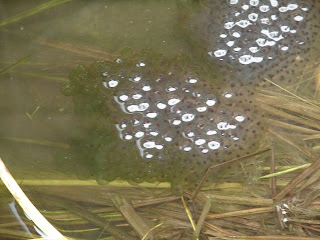
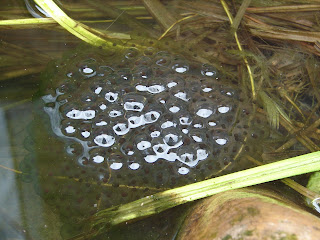
The frogs' mating season seems to have finished. A long line of clumps of frogspawn spans the shallow end of the pond. All the goldfish are now dead too, so hopefully we will have a bumper frog crop this year too!

Yesterday we spent half an hour in the garden training our espalier apple trees. I have a feeling this might be the wrong time of year to do it, but they're such strong little trees, and doing so well - absolutely covered in buds - that I can't imagine it will do them any harm. They are beautiful, even when they aren't in leaf! And some are already meeting each other in the middle. And below them the primroses are in full flower....

Friday, February 25, 2011

Another sure sign of spring...

Pabi Bach took these pictures this evening. The frogs have been singing very loudly tonight...


Wednesday, May 26, 2010

Bee Garden

After a kind request from Beth, I thought I'd give and overview of how we have (part intentionally, mostly unintentionally) created a bee and wildlife friendly garden, that also produces food and looks pretty.

We have 2 gardens, one large one at the back of the house (north facing, deep shadow cast by the house, south-facing fence, large nutrient-greedy ex-coppice ash trees that we're not allowed to cut down / coppice) and a long, narrow garden at the front (a real sun-trap, poor soil, shady corners, nice warm wall space). We live in a village that spreads over clay, chalk and sandy soils, and we seem to get the worst of all of these - mostly heavy clay, with loads of sandy ants' nests in the summer (it seems our whole estate was built on a giant ants' nest).

Over a number of years, the back garden has transformed. It used to be all lawn, with flower beds and 2 apple trees, and kids' toys. Now it has raised beds for our vegetables, compost heaps in a corner, room for the animals, a green house, and small trees and shrubs around the edges, including cider apples, hazel, crab apples, a hop vine, hawthorn, and ornamental shrubs such as lilac and viburnum. All of these plants produce flowers, and are usually teeming with bird and insect life throughout the summer, as well as providing food for us and our animals, and looking beautiful. But because we are lazy gardeners, there are also plenty of nettles and weeds, and intentional piles of sticks and logs - these too attract wildlife, as do the pond and compost heap. Some of the wildlife we've had over the years has included: hedgehogs, frogs, newts, butterflies, lizards, all kinds of birds, mice, rats (unfortunately!) and even a rare grass-snake.


^ 2007 - homemade polytunnel, raised beds growing squash, sweet corn, salads etc, ornamental and fruiting trees against the back wall


^ May 2010

The front garden however is my real baby. When I was younger, it used to be a strip of neglected lawn with a sparse hedge of rosemary bushes, with my mum's herbs and flowers growing between. There was a patch of wild (Alpine) strawberries, which were treasured treats for my sister and I on summer afternoons once we'd finished school, so sweet and soft, sun-warmed and full of spicy, tangy, sugary deliciousness. The ants tended to be in the front garden, often invading the house, and I remember my parents vainly trying to get rid of the nest right outside our front door by pooring boiling water down between the paving slabs, which formed the bumpy, uneven path I used to play hopscotch on.

However a few years ago, Mum was inspired by Beth Chatto's book 'The Dry Garden' and decided we should revamp the front garden. A couple of corners of it were already beautiful despite being very neglected, and chief among the plants were clematis, ceonothus, a Japanese quince and Phormium tenax. The rest of the garden was dug up and changed however. We had the path rebuilt, tried desperately to get rid of the perpetual weeds and improve the soil, and spent many hours building a wooden trough that ran around the edge of the garden. Although we deviated from the 'Dry Garden' inspired planting scheme eventually, we ended up with an ornamental garden that also gave us so much more - somewhere to sit and enjoy the evening sun, somewhere to grow vegetables, fruit, herbs and even green manure, and somewhere that would provide shelter and food for all sorts of wildlife.


^ June 2008


^ May 2010

2008 was the year that both gardens really came to life. I lived and breathed gardening for a while, learning about the uses of herbs from my mum, growing vegetables and gardening sustainably, eventually leading me to discover Permaculture. I created all sorts of plans for the gardens - useful plants to grow, pretty things picked up from my trips to garden centres, and planting schemes inspired by my new-found love of beekeeping, started by my Dad in 2007 (we got our first bees on May Day of that year). We got a greenhouse for free from some neighbours, allowing me to do some 'proper' gardening.
All our new ideas about gardening and wildlife, bees and animals, sustainability and Permaculture synthesised, and we have created a garden that is never quite the same from one year to the next, but remains a pleasant place to be and somewhere full of life. But onto how to create bee garden...

CREATING THE BEE GARDEN

When choosing to make a garden that is bee-friendly, it's important to consider the needs of any wildlife:
WATER. Bees, like any other wildlife, need water, and a pond or shallow bird-bath is a great way of helping bees and other creatures. It can be as simple as a shallow dish filled with a thin layer of water, or a huge pond full of plants and pondlife, but a shallow, sheltered area with stones and twigs for the bees to perch on are essential. Remember that some of the pond (usually about a third of it, at least) should always be in the shade.

FOOD. Bees feed on pollen and nectar (which they turn into honey), which both come from flowers. Bees are 'awake' from early spring to late autumn, and will be out collecting food as long as it is not raining, too windy, or too cold. They need lots of food in the spring when they have been cooped up all winter, and lots in the summer too, so they can provide enough stores for the coming winter. In Britain we have something called the 'June gap' where there is about a month when most common feed plants aren't in flower and the bees can starve. In the bee-friendly garden therefore, it's important to have plants that flower all year round.

Early Spring:
tree pollen and nectar - hazel, hawthorn, blackthorn, fruit trees
crocuses, other bulbs, dandelions,
viburnum (Himalayan species - flowers very early)
Mahonia, berberis (also edible!)
Mustard
Primrose

Late Spring:
Horse chestnut (v. good source),
Comfrey (excellent green manure too)
Field beans (braod beans)
Oil seed rape (brassica)
Ceonothus (bees love it!)
Holly flowers
Gorse
Brambles
many flowering evergreen shrubs
Lupins, peas, legumes (for bumblebees)

June Gap:
sainfoin (if you manage to make it germinate, please let me know how!)

Summer:
Lavender, Golden Rod, Rosemary, Thyme
Beans (good for bumble bees), courgettes and squashes
Borage
Honeysuckle
Himalayan balsam (an invasive weed, so be careful)
Calendula
Cardoon
Sunflowers
Hibiscus
Sage (if it's warm enough for it to flower, the bees will be all over it)
Clover (and other flowering weeds found in meadows, etc)

Autumn and Late Sources:
Ivy (very important source)

As a rule, bees and other beneficial insects like aromatic plants and herbs, while pests tend to stay away from these.

Double-headed flowers (e.g. French marigolds, most modern hollyhocks, double roses, etc.) tend to be no good to bees - single flowers are more easy for them to access.

SHELTER. Dead wood, log piles and hollow trees can all provide shelter for many different species of bees. Holes in the ground and in brick work can also be bee-friendly places, particularly for solitary bee species. If you have a sunny, sheltered spot, this is the perfect place to plant your bee-friendly plants, as these are the conditions that bees prefer to collect food in. Hedgerows are good, too. If you want to keep your own bees, you need to find a suitable apiary site, and that needs another blog post of its own! If you find you have a colony of bees that are in an inconvenient place, or find a swarm has landed in your garden, call your local beekeepers' association and see if it is possible to move them to a more secluded area. At the moment we have a small bumblebee nest in the eaves of our house. Luckily they don't cause us any problems, and we're happy to have them there!

Other ways you can help the bees include:

  • support or join your local or national Beekeeper's Association. All you need is an interest and passion, you don't have to actually keep bees to join! The British Beekeeper's Association now have a "sponsor a hive" scheme that allows you to get involved even if you don't want to keep bees yourself, and can make a great gift idea
  • support local beekeepers by buying local honey
  • don't leave empty honey jars outside with leftover honey in - always rinse away any scraps of honey. This helps to prevent the spread of disease
  • seed-bombing. Mix up some seeds of bee-friendly, non-invasive plants with soil and water, roll into balls, allow to dry and throw them onto any patches of waste ground etc. that you see.
  • don't use pesticides, etc. in your garden
  • get to know local beekeepers, etc. If you have enough land you could even let a local beekeeper keep a hive or two on your land
This is by no means exhaustive and there is plenty more to be discovered through your own garden experimentation! But by encouraging bees and generally increasing the biodiversity of your garden by growing a variety of plants and welcoming a variety of creatures, you can do your own small bit in preserving species that are not only good for the environment, but good for the human spirit (and stomach) too!

More Bees

Well, yesterday I visited the 1st swarm of the year (the one I didn't go and collect, currently the only one we have so far actually taken home to the apiary) and wow! HUGE swarm, as big as a good-sized whole colony, and boy are they busy! They have already built out about 4 frames of wax with no foundation to help them along. 3 whole frames are already full of nectar, with more throughout the rest of the hive. They're building up really quick and look like really hard working bees. The only thing is, despite the fact they've been there exactly a week now and are bringing in pollen, there is NO BROOD. So, either the queen hasn't got going yet, or she's not working, or she's dead/gone somewhere. But they look like they're doing good, so we're going to leave them to it for a while longer, and if there's still no sign, they will get a frame of eggs from another hive so they can make a new queen. We're having to breed all our own queens this year, as we don't trust the queens from last year's breeder, and Hawaiian queens have now been banned by Defra because SHB or something has been found in Hawaii...this isn't a problem though as we are really excited about breeding our own queens! Just hope it works!

And now onto a disgusting job that I had to do that I just had to write about! The other day Dad showed me that wax moths have got into some of our stored frames...this is not acceptable, as they can absolutely destroy frames and even whole hives! While Dad was working it was mine and Pabi Bach's job to squish as many adults and larvae as we could find...however Pabi Bach was too squeamish and so it came down to me (the vegetarian of the family...felt guilty and disgusted, but also got rather carried away). The larvae, when prodded in a particular part of their anatomy, explode like a zit (nice). If you don't get them there they carry on wriggling...it was a very gooey job, and not at all pleasant.


^ wax moth nest, chewed up wax and soft, spider's web-like stuff


^ adult wax moth - small grey moth with a kind of golden-brown spot on the thorax


^ a wax moth larvae in the nest


^ the picture isn't very clear, but the larvae create sort of tunnels through the wax, eventually destroying the whole lot if you don't gte rid of them.


^ More wax moth damage

Later that evening I also had to protect Pabi Bach from a cockchafer beetle that seemed intent on dive-bombing us...although harmless (except if you're a prized plant) these beetles are about 3cm long, brown, buzzy and seem to have no breaks, and so we found it pretty alarming when it flew through her window that evening and started uncontrollably whizzing around the room! (It soared menacingly over Pabi, she gave a piercing scream, I turned and started to bolt for the door when it hove into view in front of me. I stopped, it kept on coming, hit me on the mouth and went spiralling off into a corner. Meanwhile Pabi and I made a break for it). I think she owes me a few gruesome jobs now...

^ blurry pic of the mosntrous blood-thirsty cockchafer...

Sunday, March 21, 2010

Compost & Other Such Things

Yesterday we were cleaning out the animals, when it became clear the compost heap needed to be emptied a bit. There followed a fair bit of digging and removing half of the compost in readyness to put it on the raised beds next weekend. Last year we had a bit of a problem because the heap was smelly, a sure sign that we were getting the mixture a bit wrong. However I was reallly happy to find that now it has rotted down to the most beautiful loamy mixture and doesn't smell at all. It's beautiful, and absolutely crawling with life! Hopefully the grass snake will be back this year...

Recipe for excellent compost
copious quantities of each of the following:
- vegetable peelings etc
- paper, cardboard, and straw/wood shavings from cleaning out the animals
- animal droppings
- dead leaves
- worms, woodlice, etc, who should come of their own accord

allow to mix and stew. Serve on raised beds, dug in or as a mulch, and therein plant vegetables, fruits, flowers... Delicious!


The animals very much enjoyed the ordered chaos of rearranging the compost...particularly the ducks, who were slurping up every worm they could get their hands on.


And the good news is that despite a couple of days of wet weather spring is definitely here! The daffodils are finally out, having been late for St. David's Day :( ...there are nearly always bees in the park near my college collecting stunningly bright orange crocus pollen... and best of all, this week saw the first clumps of frog spawn!


Saturday, March 6, 2010

Spring Has Sprung!

The first snowdrops appeared about a month ago. In the last week or so the primroses have come up, and just this week the crocuses, which have been pushing up little buds for a while now, came into full bloom. Recently the weather has been almost summery. In the evenings when I walk back from college now the wildlife is still out and about, people are walking their dogs, there are bulbs everywhere in the parks, with great swathes of yellow and purple everywhere you look, and the kids are even playing outside well into the evenings now. Apart from the wind, which is still a little nippy, it feels like August. Everything is coming alive! Here's a look at what we've been up to recently.


^ I don't know what this evergreeen shrub is called, but the bees love it and when it's in flower it smells wonderful.


^ Hellebores


^ The garden today.


^ First Celandines
^ Cardoons sprouting up from the ground.


^ A forgotten Brussels sprout plant left over from 2 years ago!


^ Snowdrops


^ Some plants are already in full flower


^ Snowdrops again!


^ Crocuses emerging through a jungle of strawberry plants


^ First primroses!


^ Yellow crocuses amongst the wall flowers


^ Purple crocus buds

Below: Birds' nests from last year: in the climbing hydrangea (blackbird); behind the satelite dish (collared dove); an a nest from an unknown bird that fell out of the hazel tree, beautifully constructed.


Dad's Velvety Aubergines

Not exactly seasonal or eco-friendly but a great vegetarian option and perfect for evenings that are still a little chilly.

1 aubergine, cut into medium sized chunks
3 fresh tomatoes
fenugreek and coriander seeds
1 clove garlic
a little vegetable oil
salt and pepper
Fry all the ingredients together until the tomatoes have cooked down to a delicious pulp. The aubergines will still be raw and spongey, but turn of the heat and place a lid over the pan. Allow to sit for as long as possible, allowing the aubergines to steam. Reheat when you're ready to eat. The aubergines will be really velvety and melt-in-the-mouth, absolutely delicious!

NB: You can make the recipe spicier by adding chilli or cayenne. Allspice is also a nice addition.

I have been continuing with my ever-growing reading list. I recently finished Regeneration by Pat Barker, a really good read. I loved the style of the writing - simple and subtle but absolutely sublime - and the depiction of the suffering endured by both officers, infantry troops and the people who had to care for them during WW1 was incredibly moving, especially as I recently went on a college trip to the Battlefields and saw the enormous cemeteries left over from the war for myself. I'm not enjoying First Casualty by Ben Elton as much however. Although still an interesting storyline, the writing style feels clunky and crude when I compare it to Pat Barker's work. I also have a new, eco-related addition to my reading list: Whole Earth Discipline by eco-pioneer Stewart Brand. I haven't started it yet but I'm excited about reading this book as it looks like it's going to make me rethink some of my ideas about green-ness. I like the fact that it is centred on treating the Earth as a whole though, rather than just sorting out a few problems here or there. Should be interesting...I'll let you know how I get on!
Dad has visited the bees to see how they have been getting on. We are now down to 3 hives, which is fairly disappointing. Some of the hives seem to have emptied before the weather got too cold, others have clearly diwed out over the winter, and oddly didn't eat any of the vast quantities of honey and sugar we fed back to them. This is interesting though as it presents us with a number of opportunities. The first one is to learn more - I want to become a better beekeeper so that I know how to take better care of these fascinating animals who so kindly allow me to try and nurture them. The second is that we're planning to try out a number of different methods this year. We'll be giving some hives the Warre treatment - i.e. letting them make the choices for themselves - and treating others as we would normally. And thirdly, it's interesting to note that all the hives that survived are our grumpiest bees which we have captured from the wild...I wonder if this says anything about the genetically-engineered artificially produced blood lines that one buys from queen breeders or has imported from Hawaii? Dad has ordered a few more queens to arrive this year, and we're already on the swarm list. But I wonder whether angry, swarming, wild bees are better able to survive than cushy calm bees that are made by humans for humans...
And finally, I have been planning a project for when I leave college (and that will probably end up taking over my whole life for the next 50 years...hope so!). My plan is to research and experience permaculture and sustainable practice from across the world - the Americas, Africa, Europe, Asia, Australasia... in order for me to learn more about the ecosystems of the Earth and how to work with them. The idea is to make my way around the world (or as much of it as I can afford) using the most efficient transport possible, working on aid projects and learning from people who really care about working with the planet rather than against it. I intend to record my travels on the blog and maybe when I've learned from the world's best I'll be able to pass my knowledge on in other ways too. I'm beginning to look up possible places to visit but if anyone has any suggestions of places I can go or people I could contact, please leave a comment! I'll be writing more about this as the year goes on, and I hope you''ll find it as exciting as I am finding it already!
Thanks for all your comments and support through the blog - now that things are happening out there in the garden hopefully i'll have more to blog about! ^^