Showing posts with label vegetarian. Show all posts

Tuesday, August 30, 2011

My First Foray into Mushrooms

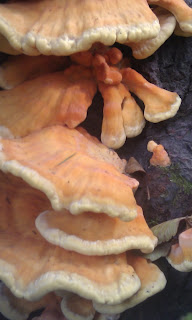
Where I walk the dog every day at the moment there is a large alder tree, and one day I spotted that it had a beautiful fungus growing on it. It seemed to have come up over night - unlikely, although I can't believe I missed it because it is so bright! I did some research and found out that it is Chicken of the Woods, aka the Sulphur Polypore, or Laetiporus sulphureus.


Apparently this is an unmistakable mushroom,even for the completely unexperienced mushroom-forager, like me. All the signs were right - the fact it was growing on a deciduous tree, its colouring (including the waves of colour around the edges), the shape and size, its suede-like surface and meaty, fibrous texture, the fact that instead of gills, it has small pores, and the time of year.


Not for nothing is it called Chicken of the Woods. It is edible, apparently very pleasant (although it is better to eat the younger parts of the fungus, as the older parts can be crumbly and dry). When I peeled off a few younger lobes I was surprised by how much its inner texture resembled cooked chicken. Anyway, I brought a small amount home to try, as apparently, although edible, it doesn't agree with everyone, and it is better to try a small amount first.


Anyway, Mammabert sauteed it in olive oil, with garlic, and made sure that it was well cooked. She didn't really want to try it, but she did. She said it wasn't unpleasant but I don't think I will manage to persuade her to sample it again. I loved it however. It was mild-flavoured, perhaps with a slight citrussy tang, and its meaty texture reminded me of Quorn. I don't eat Quorn because a) if I don't want to eat meat, it seems odd to eat something that is produced to almost exactly resemble meat in appearance and texture, and b) it uses battery eggs, and c) I don't really like it. But I really liked this Chicken of the Woods. Like natural Quorn, but nicer, with a lovely woody smell when raw.


Anyway, that was my first ever wild mushroom experience, and I haven't died yet. I did a lot of research, both on the internet and in books, before I even touched the mushroom. I recommend getting a book on Mushrooms - I've been using the Collins Gem Mushrooms, and Collins Complete Guide to British Mushrooms and Toadstools. The first one is a pocket guide with clear guidelines as to what is edible and what isn't. The Collins Complete doesn't tell you anything about whether a mushroom is edible/poisonous, but has really good descriptions and photographs to help you identify. The River Cottage handbook on mushrooms is also good, although I find the fact that it is split into two sections - one each for edible and poisonous mushrooms - a bit daft, as if your average person sees a mushroom, they have no idea which category it fits into. The Collins guides are more accessible in that the fungi are grouped according to family and appearance.


Anyway, that was my first wild mushroom foraging experience! I found it really good fun, but please don't use this blog as the only identifier for Chicken of the Woods. Get a good book or two, research on the internet, and even ask someone you know who is an experienced mushroomer. I'm a novice, so don't take my word for it on its own.


Disclaimer done. Enjoy mushrooming!

Monday, August 16, 2010

Watermelon Curry and other Culinary Adventures

Dad went to a music festival over the weekend, and came back with a watermelon and some greengages he found in a hedgerow! Greengages are one of my absolute favourite treats; their season is so short and they're harder to find than other types of plums, but I think they have the best flavour. We used to eat them on the beach in Brittany, getting sandy and sticky with juice all at once. I can't believe he found them just growing in a hedgerow!

Anyway, there was this watermelon, and I had no idea what we were going to do with it. Then I remembered that at Christmas my grandparents gave Pabi Bach and I a book called 'The Modern Vegetarian' by Maria Elia, and that there were a few recipes for watermelon in it. So we chose the 'Watermelon curry with black beans and paneer' - only without the paneer, and with mixed beans and chickpeas instead of black ones.


It's a really delicious recipe - Pops found it a bit hot but the mixture of spicy and sweet is really refreshing and brings out the flavour of the watermelon (and I like it hot - as far as I'm concerned a curry's only good if it makes my nose run!). I know it sounds weird but as you cook it it starts to smell delicious. It's got a sweet edge but looks more like it's cooked with tomatoes than strange pink fruit!
It's a really interesting book actually; the recipes are so original and pieced harmoniously together from many different cuisines. It's a bit adventurous for everyday, but we've tried a few things from it and they've all been delicious. And if you have a sudden surprise watermelon sprung on you there are actually a total of 4 recipes for it. Definitely recommend it, and for everyone who likes their fruit and veg - not just vegetarians.
Anyway we made the curry. It was delish. And in the cooking process we discovered a couple of ways of eating raw watermelon which are delicious.

The first is to sprinkle your watermelon chunk with salt and tuck in. Yum! Try it with pepper too.
The second is to chop up your chillis for the curry. Then plonk a load of watermelon on top of where you've just been cutting chilli. Take a bite. Hot but heavenly!!


Apart from this we also stewed the more squooshy of the greengages. I stoned some more mirabelles and we had these fresh for pudding, along with some of the apple and blackberry mixture from Sunday lunch and then banana and Ambrosia custard. Lush.
Yesterday we had Grandad John (adopted, but nonetheless adored) round for Sunday lunch - roast lamb for the meat eaters, all the veg (including our slightly unusual family tradition of having spicy roast butternut squash and/or aubergine with the usual potatoes, peas, etc) as well as the first of our runner bean crop! And Pabi Bach cooked a delicious Blackberry and apple pie with a pastry lattice top. Everyone tucked in, but I'm afraid that yours truly ate it for a midnight snack before I could take a picture to show you all. But it was beautiful. And delicious.

^ no picture of the pie, so flowers from our garden instead ^^

Anyway, off round to Mum's tomorrow night for more culinary fun... ;)

Thursday, August 5, 2010

Holiday Chips

Here's a quick recipe that my friend McFrizz and I invented on our trip to Brighton - it makes the naughtiest chips ever, really delicious. Enjoy!

Ingredients:
potatoes and/or sweet potatoes (quantity depends how hungry you are!)
a little sunflower or other vegetable oil
a couple of tbl sp honey
a pinch of dried mixed herbs (or fresh; try thyme, oregano, marjoram, savoury, rosemary, or even a very little lavender maybe...)
a pinch or two of cayenne pepper

1. Preheat the oven to hot, about 200 degrees C. Place a large roasting tin therein with a little oil in to heat.

2. Meanwhile chop the potatoes into chunky chips. When the oven has heated, place the chips into the roasting tin, tossing them around in the oil. Replace in the oven at 200 degrees C still, and check after 25 - 30 mins.

3. When the chips are almsot done (they might take up to 45 mins, or will be quicker if you follow the tip below) drizzle and sprinkle on the honey, mixed herbs and cayenne pepper and toss again. Replace in the oven for another 5 - 10 minutes until the chips are cooked and just turning brown at the edges.

4. Serve and guzzle greedily!

Tip: the chips will cook quicker if you par-boil them for 10 - 15 minutes before roasting.

I think they'd be brilliant with a salad with a light honey and mustard dressing or could make a wicked chip butty ;)

Monday, May 24, 2010

Bees & Garden

We've had a while of miserable weather but the last few days have been very hot indeed, and this has definitely shown in terms of the number of calls we've had about swarms! We've had 3 in the past week (not all of them turned out to be honey bees however), and have carried out an artificial swarm on our existing hive, and so at present we have 3 colonies and possibly another 1 on the way...


^ Queen with long abdomen (sorry for blurry pic)


^ Artificial Swarm taking place

The first call we got was to a beautiful old house in the countryside which is being converted into flats. The foreman had spotted the bees clustered on a tree trunk in the sunshine. When we arrived the "swarm" had gone and what we were left with was a wild colony living in the dead tree trunk, with only an inch square hole for access. Unfortunately the tree is being cut down and so they will have to move, but fortunately the foreman seemed very reluctant to kill them. We pondered and pondered how we could possibly rescue the bees, as the queen will never leave her home and brood. In the end Dad constructed a cardboard box with a one-way bee escape in, so that any bees flying out would be redirected to a hive on a raised platform. That way we'll the get the flyers at least, and although they'll be queenless, they may be able to start afresh with a few nurse bees and a frame of eggs. The queen and her brood will have to be left there (and destroyed) but that's life, bees and humans don't always get along.


The second call I didn't go to, but I gather it was a straightforward swarm collection and the bees are now installed in the apiary! The third call turned out to be bumble bees, but if the weather continues to be as good as it is there should be plenty more opportunities for us to stock up on new colonies.

I'm a great believer in collecting swarms and the merits of wild colonies; not only do you get a new colony for free, but you can be assured that you're getting bees whose natural instincts are sound. Of course there is always the slight risk that they'll be hideously grumpy or carrying diseases, although swarming is often a good way to minimise disease, and swarming bees tend to be at their most docile. The only hive of ours who survived the winter and have made a good start this year are the wild colony we collected from the wall (see the video blog). And despite being moved fairly late in the year last year, they still made loads of lovely honey and laid down good stores for them and for us. This made me realise that bees that can survive without human meddling are the most likely to survive overall - if they can take care of themselves, they're less likely to produce dud queens, starve to death, be lazy or too grumpy, or freeze to death. They've done it all before in the wild, so of course they'll survive in a nice new hive where the wax is already started for them. Last year we bought a bunch of new mated queens from a local bee breeder. Every single colony failed, and in every case it was because the queen hadn't taken or had stopped laying, and I recently heard that another keeper in our association had the same problem with queens from the same breeder. And while this might just be that one individual breeder, it can't be denied that we humans breed bees that have the characteristics that are convenient for us (docility, good honey production, lack of swarming instinct). But the more I learn about bees, the more I begin to realise that these characteristics aren't good for them - is it any wonder that they're dying out if their natural instincts are being suppressed? With wild or swarming bees, you know that they're following their instincts and are doing what comes naturally to them, and this can only be a good thing. "Natural" bees should be resilient, self-regulating and completely uninterested by human activity. Perhaps by breeding bees to illiminate problems, we are creating more problems? Let me know what you think!

And onto the garden. The first beans have been planted out in a heavy mulch of homemade compost (mulching helps retain moisture, good plant food, no digging required, and also I was too lazy to prepare the ground earlier this year, woops!), but I've run out of canes so the others will have to wait; however, I am now watering them religiously and despite a tussle with the rabbits (evidence: white fur all over munched lower leaves and stems) they're making a good go of it. We've got a few lettuces and peas on the go too, as well as our tomatoes, chillis and peppers, but we need more! So now that I am on study leave, I'm hoping to be able to get out in the garden a bit more (when I'm not studying lol) and sort things out a bit.


As for compost, last year we tried an enclosed compost heap called the "Green Johanna" which allows you to compost cooked food and even meat, dairy and fish. As a result of this we had a rat infestation for a while, although this could also possibly have been because of the building works next door, as the rats disappeared after the building stopped...anyway, we stopped using the Green Jo' and have left it for almost a year...and now it is full of the most wonderful loamy, soft, fine, moist, rich, dark lovely compost! I can't wait to get using it. It doesn't smell at all and has the most wonderful texture, part of me wishes I could roll around in it!


Anyway, I shall leave you with a delicious recipe that Dad made up this evening - wonderful with a slice of toast or good nutty brown rice ^^

Dad's Leek & Bean Summer Stew


Ingredients:

5 dry red chillis, crushed (or your preference, we like things hot ^^)
3 leeks, chopped
2 courgettes, sliced
1 onion, chopped
1 tin of black eye peas, drained
1 tin of chick peas, drained
salt and pepper

It's easy - stick all in a pot with a little stock or water, and cook with the lid on until the leeks and courgettes are soft and sweet. Delicious!

Saturday, March 6, 2010

Spring Has Sprung!

The first snowdrops appeared about a month ago. In the last week or so the primroses have come up, and just this week the crocuses, which have been pushing up little buds for a while now, came into full bloom. Recently the weather has been almost summery. In the evenings when I walk back from college now the wildlife is still out and about, people are walking their dogs, there are bulbs everywhere in the parks, with great swathes of yellow and purple everywhere you look, and the kids are even playing outside well into the evenings now. Apart from the wind, which is still a little nippy, it feels like August. Everything is coming alive! Here's a look at what we've been up to recently.


^ I don't know what this evergreeen shrub is called, but the bees love it and when it's in flower it smells wonderful.


^ Hellebores


^ The garden today.


^ First Celandines
^ Cardoons sprouting up from the ground.


^ A forgotten Brussels sprout plant left over from 2 years ago!


^ Snowdrops


^ Some plants are already in full flower


^ Snowdrops again!


^ Crocuses emerging through a jungle of strawberry plants


^ First primroses!


^ Yellow crocuses amongst the wall flowers


^ Purple crocus buds

Below: Birds' nests from last year: in the climbing hydrangea (blackbird); behind the satelite dish (collared dove); an a nest from an unknown bird that fell out of the hazel tree, beautifully constructed.


Dad's Velvety Aubergines

Not exactly seasonal or eco-friendly but a great vegetarian option and perfect for evenings that are still a little chilly.

1 aubergine, cut into medium sized chunks
3 fresh tomatoes
fenugreek and coriander seeds
1 clove garlic
a little vegetable oil
salt and pepper
Fry all the ingredients together until the tomatoes have cooked down to a delicious pulp. The aubergines will still be raw and spongey, but turn of the heat and place a lid over the pan. Allow to sit for as long as possible, allowing the aubergines to steam. Reheat when you're ready to eat. The aubergines will be really velvety and melt-in-the-mouth, absolutely delicious!

NB: You can make the recipe spicier by adding chilli or cayenne. Allspice is also a nice addition.

I have been continuing with my ever-growing reading list. I recently finished Regeneration by Pat Barker, a really good read. I loved the style of the writing - simple and subtle but absolutely sublime - and the depiction of the suffering endured by both officers, infantry troops and the people who had to care for them during WW1 was incredibly moving, especially as I recently went on a college trip to the Battlefields and saw the enormous cemeteries left over from the war for myself. I'm not enjoying First Casualty by Ben Elton as much however. Although still an interesting storyline, the writing style feels clunky and crude when I compare it to Pat Barker's work. I also have a new, eco-related addition to my reading list: Whole Earth Discipline by eco-pioneer Stewart Brand. I haven't started it yet but I'm excited about reading this book as it looks like it's going to make me rethink some of my ideas about green-ness. I like the fact that it is centred on treating the Earth as a whole though, rather than just sorting out a few problems here or there. Should be interesting...I'll let you know how I get on!
Dad has visited the bees to see how they have been getting on. We are now down to 3 hives, which is fairly disappointing. Some of the hives seem to have emptied before the weather got too cold, others have clearly diwed out over the winter, and oddly didn't eat any of the vast quantities of honey and sugar we fed back to them. This is interesting though as it presents us with a number of opportunities. The first one is to learn more - I want to become a better beekeeper so that I know how to take better care of these fascinating animals who so kindly allow me to try and nurture them. The second is that we're planning to try out a number of different methods this year. We'll be giving some hives the Warre treatment - i.e. letting them make the choices for themselves - and treating others as we would normally. And thirdly, it's interesting to note that all the hives that survived are our grumpiest bees which we have captured from the wild...I wonder if this says anything about the genetically-engineered artificially produced blood lines that one buys from queen breeders or has imported from Hawaii? Dad has ordered a few more queens to arrive this year, and we're already on the swarm list. But I wonder whether angry, swarming, wild bees are better able to survive than cushy calm bees that are made by humans for humans...
And finally, I have been planning a project for when I leave college (and that will probably end up taking over my whole life for the next 50 years...hope so!). My plan is to research and experience permaculture and sustainable practice from across the world - the Americas, Africa, Europe, Asia, Australasia... in order for me to learn more about the ecosystems of the Earth and how to work with them. The idea is to make my way around the world (or as much of it as I can afford) using the most efficient transport possible, working on aid projects and learning from people who really care about working with the planet rather than against it. I intend to record my travels on the blog and maybe when I've learned from the world's best I'll be able to pass my knowledge on in other ways too. I'm beginning to look up possible places to visit but if anyone has any suggestions of places I can go or people I could contact, please leave a comment! I'll be writing more about this as the year goes on, and I hope you''ll find it as exciting as I am finding it already!
Thanks for all your comments and support through the blog - now that things are happening out there in the garden hopefully i'll have more to blog about! ^^

Tuesday, July 28, 2009

Vegetarian Supper

Recently I've turned vegetarian-bordering-on-vegan, due to a number of reasons:
  • Animal welfare. I don't really see anything wrong with eating free range local meat, especially if you're supporting local business at the same time. However it's just so easy to use chicken stock cubes etc. which of course use the cheapest possible chicken. And I don't want to eat animals that haven't ever seen the sunshine.
  • Disgust. For some reason the idea of eating animal products disgusts me. Pork chops turn to dust in my mouth, eggs I can't stand (unless they're in chocolate cake or something ^^). I've always been fussy but recently I've just really gone off animal products, even my mum's shepherd's pie and my dad's butter chicken! I still eat honey though, of course.
  • Health. I lost 2 kg in my first week of being veggie!
  • I like it. I just like lentils and beans and veg!

Anyway, last night I had what can only be described as a vegetarian feast:

  • Okra with lemon, my dad's recipe
  • Mixed veg curry
  • Rice
  • Fresh peas
  • Fried mushrooms
  • and the others had a pork chop each as well.

So here are some recipes!

Dad's Okra with Lemon

I just love okra, and I think it's in season at the moment. My plants haven't done anything yet but who knows what August may bring? The ones we used yesterday were from Thailand (eek, food miles!) but I just can't resist okra, the minute I see it any green principles fly out the window I'm afraid.

Anyway:

  1. Add a bit of oil to a large pan and heat. I used organic rapeseed oil.
  2. Top and tail the okra, and wash. I used 2 smallish packets to feed 4 of us.
  3. Add the okra to the hot oil and move around the coat them in it.
  4. Continue moving the okra around the pan for around 15 - 20 minutes. They'll release a sort of clear goo. Keep cooking until the goo stops and the okra have gone soft. They should still be green but the smaller ones will be tinged with brown in places.
  5. When the okra are cooked, add the juice of half a lemon to the pan, and stir. Chuck the squeezed lemon half into the pan too, for extra flavour. Cook for another couple of minutes to infuse the okra with the lovely lemony-ness.
  6. Serve nice and hot. I think something crunchy, e.g. toasted sesame seeds, would be nice sprinkled over the top.

Mixed veg curry

We just used whatever was in the cupboard, fridge and garden yesterday! You can use any sort of veg you happen to have lying around. This is how we made last night's version:

  1. Chop an onion fairly finely, and crush a clove of garlic.
  2. Heat a glug of organic rapeseed oil in a hot pan, and add the onion and garlic.
  3. Chop up 2 carrots and a couple of celery sticks - not too big and not too small. Add to the pan.
  4. Add French beans (topped and tailed) and runner beans (topped, tailed, de-stringed and sliced) chopped in half widthways.
  5. Add some fresh tomatoes straight from the garden.
  6. Add some tinned tomatoes too.
  7. Tip in a can of chickpeas.
  8. And stir in a sachet of curry powder,
  9. Leave to stew until everything is soft and lovely, but hasn't lost its colour.

And another of my favourtie vegetarian foods:

Sweet Potato chips

  1. Chop some sweet potatoes into thin chips. We use 1 tuber per person (though I could quite happily munch on more, to be honest!).
  2. Add some oil to a deep roasting tin. Tip in 1.5 tsp of cumin seeds and 1 tsp of black mustard seeds, or the herbs and spices of your choice.
  3. Heat the roasting tin in a hot oven (200 - 220 degrees, I reckon) until the mustard seeds start to pop.
  4. Bring the tin out of the oven and tip in the sweet potato strips. Mix around a bit to coat them in the oil and spices.
  5. Put back into the oven and cook for around 20 mins or until soft and just beginning to char and caramelise at the edges.

There you have it! Sorry there are no pictures, but there's never any left for me to photograph!